Change Language :

Container terminal
Shore power supply for container terminals
Container terminals operate in highly optimised, space-constrained environments where berth productivity, crane utilisation and vessel throughput have a direct impact on profitability. Shore power systems in container terminals need to be integrated into these workflows without limiting berth flexibility or causing operational constraints.
For container terminals, the challenge is not to comply with IEC 80005-1, but to overcome the connection dilemma created by fixed shore power connections, limited cable ranges and constantly changing ship positions.
Shore power requirements for container terminals in accordance with IEC 80005-1 standards
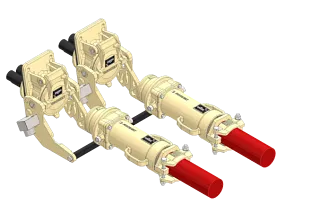
The IEEE/IEC/ISO 80005-1 standards for high voltage shore connections contain comprehensive information on the design, installation and testing of HVSC (High Voltage Shore Connection) systems. They provide general guidelines for HVSC systems as well as specific appendices for certain ship types. Appendix D is particularly relevant for container ships. This section contains specifications that ensure the global interoperability and safety of the systems through defined test parameters.
Some of the most important design features for container terminals and ships are:
- The cable management system must be located on board the ship.
- The nominal voltage of the system must be 6.6kV.
- For HVSC systems with a maximum power consumption of 7.5MVA, two parallel cables with three pilot conductors each must be used.
- The connector configuration includes 3x main phase, 1x PE, 3x pilot pins.
The "connection dilemma" at the container terminal

PLACEHOLDER Infographic 1 - "Limited length of cable from the ship"
Challenge No. 1:
Limited cable length of fixed outlet vaults
- According to IEC 80005-1, only 10 metres of cable are required on land, which means about 10 metres to the left and 10 metres to the right of the discharge point of the outlet - a total horizontal connection range of about 20 metres.
- In real-world container terminal operations ...
- ... the cable length is consumed by bend radii and vertical travel.
- ... the tidal lift and loading and unloading processes of the ships can lead to vertical movements of up to 20 metres in some places.
- ... even short horizontal displacements quickly lead to the usable cable length being exceeded
This severely restricts the mooring possibilities of a ship that is to be connected to shore power.
PLACEHOLDER Infographic 2 - "Many possible locations for laying cables"
Challenge No. 2:
Many possible locations for laying the cable
Container ships vary greatly in size and design, which leads to the following problems:
- Shore power inlets near the stern, amidships or near the bridge
- Significant differences between Panamax, Post-Panamax, New Panamax and ULCV vessels
- Both port and starboard berth configurations
To accommodate this variability using fixed outlets, terminals must either:
- install many connection points along the quay,
or
- accept that shore power will only work for certain vessels at certain positions, reducing operational flexibility
Both options increase costs and reduce future adaptability.
Challenge No. 3:
Different berths every day
The profitability of container terminals depends on the optimisation of berth allocations:
- Ship size and schedule
- Availability of cranes
- Yard and shore-side operations
As more and more ships have shore power, the number of connection points required increases. Adding more fixed outlet vaults is costly - and yet does not fully future-proof the terminal.
This raises a fundamental question:
Why should ships be forced to dock near shore power instead of bringing shore power to the ship?
Why fixed connection points in the shore power supply fall short
Fixed connection points for the shore power supply are based on the following points:
- Predictable ship positioning
- Limited variability in the location of the sockets
- Static berth utilisation over time
These assumptions have lost their validity in relation to modern container terminals.
Fixed infrastructure elements quickly become a hindrance to operations rather than a facilitator.
The resolution of the dilemma ... with the iMSPO
The igus Mobile Shore Power Outlet (iMSPO) was specially developed for the conditions in container terminals.
Instead of having to install several fixed mounting points along the quay ...
- the iMSPO decouples the electrical infrastructure from the mounting point,
- the iMSPO brings the shore power connection directly to the ship
- the iMSPO adapts to changing ship sizes, entry positions and berth assignments.
The most important advantages for container terminals at a glance:
- One mobile system can serve multiple berthing positions
- No dependence on the limited IEC minimum cable length at the vault
- Reduced need for additional fixed socket vaults
- Full support for port and starboard berths
- Compliance with the electrical and safety requirements of IEC 80005-1
Designed for long-term flexibility at the terminal
Container terminals are constantly evolving. Ship fleets are changing, berthing strategies are shifting and legal requirements are increasing.
By investing in mobility at the mounting point, terminals can
- Protect the productivity of the berth
- Reduce the risk of obsolete infrastructure
- Further expand shore power capacity without repeated construction work
The igus Mobile Shore Power Outlet enables shore power to support terminal operations rather than hinder them.
Mobile power socket supplies container ships at the Port of Hamburg
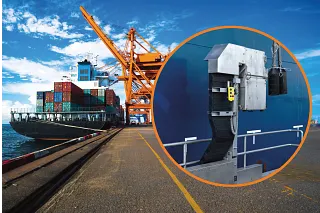
The iMSPO (igus Mobile Shore Power Outlet) is a mobile "power outlet" that runs along the quay on a travel of up to 400 metres, providing shore power directly to the docked ship. The Port of Hamburg uses three of these systems at the CTH.
At the Container Terminal Hamburg (CTH), the port relies on a pioneering solution from igus: the Mobile Shore Power Outlet (iMSPO). Three movable systems with integrated rol e-chains supply container ships with power along 300, 150 and 110 metres of quay length with pinpoint accuracy - regardless of their berthing position.
The iMSPO systems move on a specially developed steel structure above the flood wall. This ensures maximum safety, saves space and enables a quick connection in under 15 minutes - with just two people. The robust energy chain reliably guides the heavy cables and protects them from wear.
The result: Fewer emissions, lower operating costs and more flexibility for port operations - honoured with the title "Port Innovation of the Year".
Our solutions

igus® Mobile Shore Power Outlet
With a modular and flexible product range, we can develop a solution that suits your terminal and fits seamlessly into your workflow.
- iMSPO® assembled on the quay wall
- iMSPO® on a customised steel structure
- iMSPO® in a trench in the terminal
- Special solution – e-chain reel
Services


ASI Automatikk AS Distributor+47 9006 1100