Change Language :
Small plastic spherical bearings for compact designs
Space-saving, lightweight and maintenance-free spherical bearings
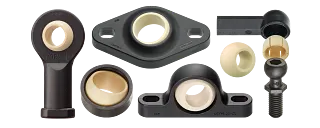
Where are small spherical bearings used?
Compact spherical bearings are required when it is necessary to achieve pivoting, tilting or rotational movements in confined spaces, to transmit linear movements, to avoid edge loads, or to compensate for misalignment.
As the higher loads that metal spherical bearings can withstand are not required in many designs, maintenance-free spherical bearings made from high-performance plastic represent a sensible alternative in many applications. Particularly in situations where regular re-lubrication would otherwise be necessary, where components are exposed to moisture or splashing water, or where weight is a crucial factor.

Lightweight for moving structures
In the case of moving structures, it is not only the payload that influences the required drive torque. The bearings and connecting elements themselves are also part of the moving mass and must be accelerated and decelerated with every movement. igubal components are made from high-performance plastics and, depending on the design, are up to 70 per cent lighter than comparable steel versions. This provides constructive clearance in applications involving high motion cycles, short acceleration distances or limited drive power – for example, in dynamic mechanisms, robots, grippers or aircraft.

Lubrication-free and maintenance-free bearings
igubal spherical bearings contain solid lubricants integrated into the material, meaning that relubrication is not required and no lubricant can escape into the environment. This offers a huge design advantage when regular maintenance is only possible at extra cost or when the use of lubricants is undesirable.

Resistant to corrosion and chemicals
Plastic does not corrode; depending on the material, it is resistant to a wide range of chemicals and does not require any additional surface treatment. This means that plastic spherical bearings can also be used in designs where moisture or chemical cleaning are a factor.

Quiet operation and vibration dampening
Tribologically optimised materials exhibit different friction and dampening specifications to metallic bearing pairs. They help to ensure quiet operation and dampen vibrations. Ideal for applications where noise and vibrations are perceived directly at the structure itself.
Easy to see in the video: the AIDIN hand with igubal KBRM rod end bearings in the finger and thumb kinematics
Humanoid robot hand
Plastic rod ends optimise finger kinematics in an anthropomorphic robotic hand
The AIDIN hand from AIDIN ROBOTICS demonstrates how crucial the interaction between design, sensor technology and mechanics is. While sensors and software do the "thinking", it is the mechanics that physically realise every movement.
As part of this collaboration, the metal rod ends originally used in the finger and thumb kinematics were replaced by igubal rod ends of the KBRM-02 series as early as 2022. The aim was to reduce weight and at the same time ensure consistent, reliable movement. The plastic solution has been successful in series production ever since:
- Maintenance-free operation without lubrication
- Low weight for dynamic movements
- Quiet operation for smooth kinematics
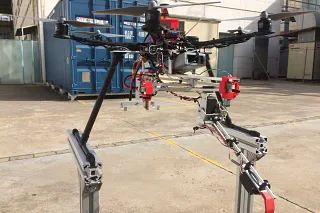
Cartesian manipulator
Pillow block and flange mounted bearings support the precise movements of the drone manipulator
For this drone, which has been developed for inspection and maintenance tasks, reliable and controlled movement of the manipulator arm is essential. In addition to the linear guides and the spring-assisted arm, the bearings used fulfil a key mechanical function: They ensure the precise guidance of the moving components and facilitate controlled force transmission during interaction with the environment.
An EFOM-06 flange mounted bearing is used in the spring-lever mechanism of the flexible joint, and two ESTM-06-SL pillow block bearings are used to support the sliding gripper. The igus bearings stand out for the following reasons:
- Smooth-running and maintenance-free articulation and gripper movement
- Lightweight for use in the air
- Corrosion resistance for outdoor use
Further examples of applications for compact plastic spherical bearings


ASI Automatikk AS Distributor+47 9006 1100